China's pig towers: can a skyscraper fix the environmental cost of meat?
China builds 26-storey pig farms and calls them efficient. The numbers on emissions, land, soy and water tell a different story.
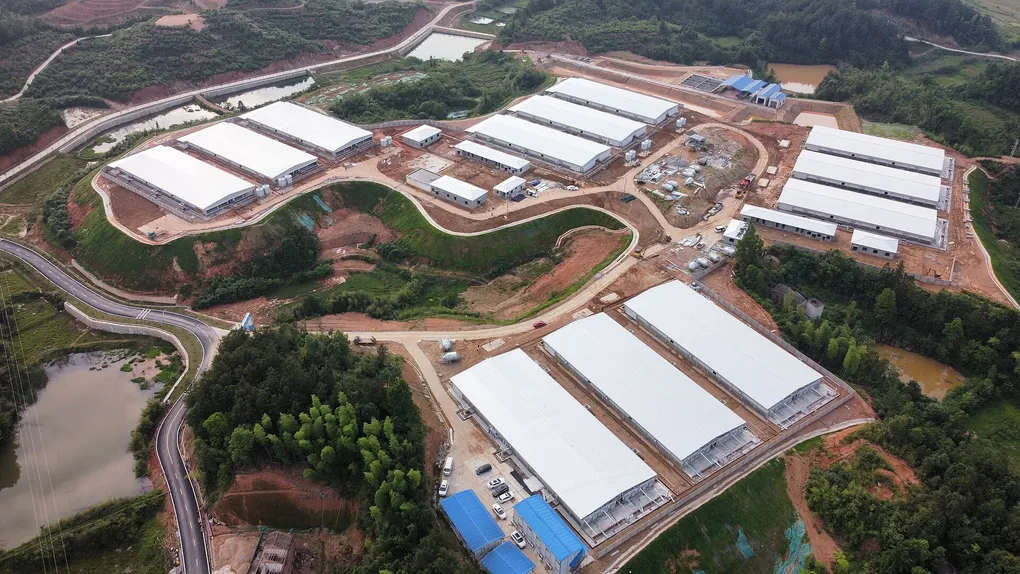
In Ezhou, in China’s Hubei province, a 26-storey building houses pigs instead of people. Opened in 2022 by a former cement company, the tower cost 2 billion yuan and was designed to raise 600,000 pigs a year, with plans for a second tower that would double that figure. Feed travels up by lift, workers live on site for weeks at a time, and every floor runs like a separate farm.
The pig tower has become the symbol of a new phase. In October 2026 China’s agriculture ministry published its livestock plan for the next five years, and for the first time it sets no target for producing more meat. Officials say pork consumption has “largely peaked”. The new goals are about doing the same with fewer resources: more “smart” and large-scale farms, less antibiotic use, more manure put to use. Already 76.9% of the country’s livestock is raised on large farms.
So is this the answer? Can animal farming become sustainable if it is simply made bigger and more efficient?
What “efficient” really means
There is some truth in the efficiency argument. The UN Food and Agriculture Organization (FAO) recommends raising productivity, because a large, well-run farm can produce a kilo of meat with fewer emissions than a small, inefficient one. Emissions per kilo have fallen for most animal products in the last twenty years.
But the planet doesn’t feel emissions per kilo. It feels the total. And the total keeps growing: in 2025 China produced 100.72 million tonnes of meat, the most ever, and slaughtered 719.73 million pigs in a single year, according to its National Bureau of Statistics. China alone raises about half of the world’s pigs.
A tower also doesn’t solve the biggest part of the problem, which is not inside the building at all: feed.
The soy that crosses the ocean
Pigs in towers eat soy and corn. In 2025 China imported a record 111.8 million tonnes of soybeans, about three quarters of them from Brazil. Most of that soy becomes animal feed.
Researchers at Trase and the Stockholm Environment Institute link Brazilian soy exports to the clearing of native vegetation, especially in the Cerrado, a savanna rich in species. In 2020 the soy bought by China was associated with about 229,000 hectares of deforestation, more than any other market. A farm can be spotless inside and still depend on a forest being cleared on the other side of the world.
Even the industry knows feed is the weak point: in 2026 Muyuan, the world’s largest pig producer, cut the share of soymeal in its feed from 10% to 7.3%.
A life that never sees the outside
Behind the numbers there are animals, and this is the part the brochures leave out.
Pigs are not simple creatures. A review of the scientific literature (Marino and Colvin, International Journal of Comparative Psychology, 2015, a study funded by the sanctuary group Farm Sanctuary) describes them as cognitively complex, comparable to dogs and some primates: they learn, remember, recognise each other and have individual personalities. In the wild, or in a sanctuary, a pig can live 15 to 20 years.
In the towers, life is measured in months. In Ezhou, piglets are separated from their mothers about 23 days after birth, earlier than the minimum of 28 days recommended by the European Food Safety Authority (EFSA), and the pigs are sent to market after 6 to 8 months. The whole building is sealed and climate-controlled to keep diseases out: no report describes any pig ever going outside. In Muyuan’s complex in Neixiang, Henan, 21 six-storey buildings produce more than 1.7 million pigs a year, and the pigs never leave the complex at all: the slaughterhouse is inside it.
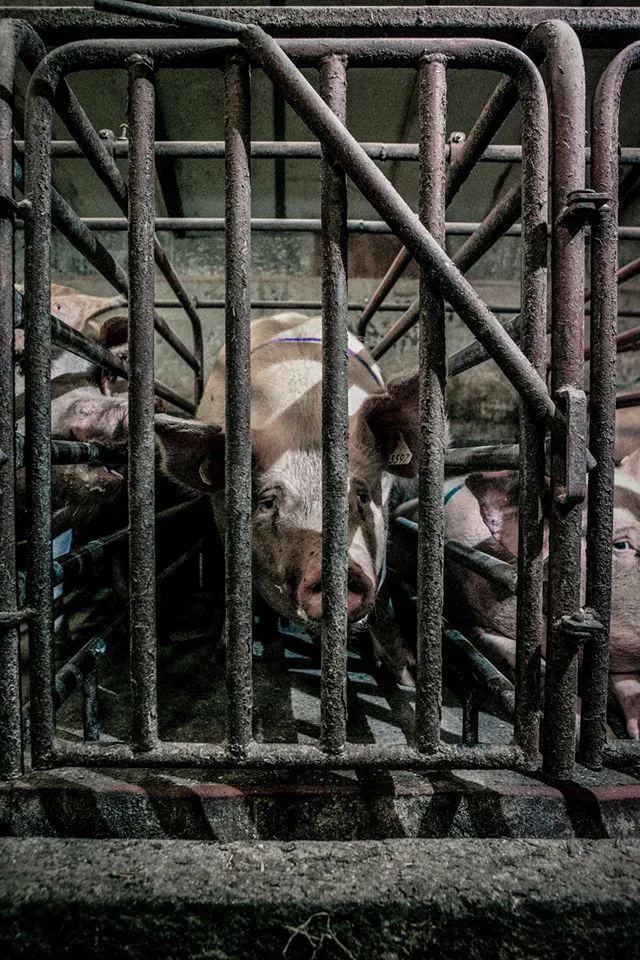

The mothers pay the highest price. In intensive farms, breeding sows are often kept in metal stalls about 2 metres long and 60 to 76 centimetres wide, where they can stand up and lie down but cannot turn around. Compassion in World Farming reports that Chinese multi-storey farms use these stalls and farrowing crates. In the United Kingdom sow stalls have been banned since 1999; in the European Union sows must be kept in groups for most of their pregnancy since 2013. In China there is no national animal welfare law that regulates how pigs are raised.
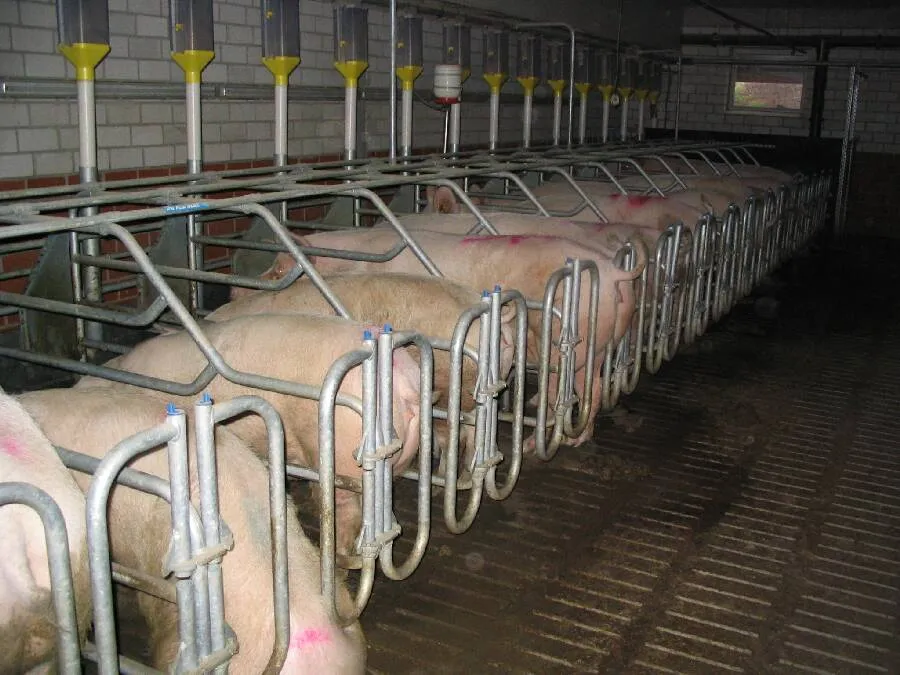

EFSA calls tail biting a sign of unmet needs, and the routine clipping of piglets’ teeth “inherently injurious”. A building can control temperature, air and water to the degree. What it cannot give is what a pig is: an animal that wants to dig, explore, move and live.
The industry’s answer is more technology. In September 2026 Muyuan’s president, Gao Tong, told a conference in Beijing that the company runs more than 3.3 million “intelligent devices” on its farms. They track body temperature, feeding and behaviour, so that artificial intelligence can spot a sick pig before the symptoms show. He said this has reduced deaths and antibiotic use, but gave no figures, and no independent audit has checked these claims. A sensor can notice that a pig has a fever. It cannot open the door.
We call it what it is. A system that keeps intelligent, feeling animals sealed indoors for their whole short life, and calls it progress, is not progress. It is cruelty made more efficient.
The numbers behind animal farming
- Climate. In 2023 the FAO estimated that livestock produces 6.2 billion tonnes of CO2 equivalent a year, about 12% of human emissions. Its 2013 estimate was 14.5%; the difference comes mainly from a new calculation method, not from a real fall. A 2021 study in Nature Food found that animal-based foods cause 57% of the emissions from food production, about twice as much as plant-based foods.
- Land. According to the largest analysis of food systems (Poore and Nemecek, Science, 2018), meat, fish farming, eggs and dairy use about 83% of the world’s farmland but provide only 18% of our calories.
- Water. Animal products account for nearly a third of agriculture’s water footprint (Mekonnen and Hoekstra, 2012).
- Pollution. China’s own pollution census found that livestock was responsible for more than 40% of the country’s water pollution from organic matter, nitrogen and phosphorus (2017 data).
Bigger farms, bigger stakes
Concentrating hundreds of thousands of animals in one place also concentrates risk. Between 2018 and 2019 African swine fever spread through China’s pig farms and wiped out a large part of the national herd. In 2020 a study in PNAS described a swine flu strain, G4, dominant in Chinese pigs since 2016 and able to bind to human cells: 10.4% of the pig farm workers tested had antibodies to it. Pig towers answer with showers, tests and disinfection at every entrance. It works as long as nothing gets in.
And not every tower works. In Quzhou, in Zhejiang, a farm built to produce 240,000 piglets a year has stood empty since it was finished in 2021. The company that ordered it blames construction defects, including unsafe manure ditches; the builder disputes this. The dispute helped push the company to an expected loss of over a billion yuan in 2025.
The question that remains
China’s new plan shows that even the world’s largest meat producer has stopped promising “more”. That is news. But a plan to make the same system more efficient does not ask the question that matters most: if most of the land, a large share of the emissions and a whole forest’s worth of soy go into producing animals, is a taller building the solution, or a way of not looking at the problem?
The most efficient farm is still a farm that needs to feed hundreds of thousands of animals. A meal made from plants skips that step entirely.
Sources
Every figure in this article comes from these sources.
- AgNavigator, "China emphasises AI and smart livestock farming as pork industry enters post-growth era", 7 Oct 2026
- Jiemian, the Ezhou 26-storey pig farm (about Nov 2022)
- Pig Progress, the 26-storey pig house (design capacity with two towers)
- National Bureau of Statistics of China, 2025 output, 19 Jan 2026
- Reuters via Manitoba Co-operator, soy in Chinese pig feed, 7 Apr 2026
- Soy imports by origin, 2025 (S&P Global, Reuters)
- SEI / Trase, Brazilian soy exports and deforestation
- FAO, livestock emissions report, 8 Dec 2023
- FAO, *Tackling climate change through livestock*, 2013
- Xu et al., *Nature Food*, 2021
- Poore & Nemecek, *Science* 360:987, 2018
- Mekonnen & Hoekstra, *Ecosystems* 15:401, 2012
- China's Second Pollution Source Census (2017 data), summary
- Sun et al., *PNAS*, 2020 (G4 swine flu)
- Guardian via Yahoo, the Ezhou tower, 25 Nov 2022
- Huanqiu (Global Times), life cycle in the Ezhou tower, about 6 Jul 2023
- China Daily, Muyuan's Neixiang complex, 31 Dec 2024
- Marino & Colvin, "Thinking Pigs", *International Journal of Comparative Psychology* 28, 2015
- EFSA, scientific opinion on the welfare of pigs on farm, *EFSA Journal* 2022;20(8):7421
- AVMA, literature review on gestation sow housing, 2024
- EU Council Directive 2008/120/EC (pig welfare)
- RSPCA Assured, farrowing crates and the 1999 UK stall ban, 22 Sep 2025
- Voiceless Animal Cruelty Index, China
- Compassion in World Farming, "The concerning rise of multi-storey pig farms in China", 2023 (advocacy position paper)
- AgNavigator, "How pork giant Muyuan Group deploys AI to manage the world's largest pig herd" (Gao Tong at the WAFI conference, Beijing), 23 Sep 2026
- Caixin Global, the Quzhou pig farm, 13 Feb 2026